Showing posts with label mourning. Show all posts

Tuesday, June 27, 2017

Grow Up! The Condolence Basics You Need Now. Part 1

Grow Up! 

How many times did you hear that before you were 25? Are you still hearing it in your 30's or 40's? If so, someone is trying to persuade you toward mature choices. "Grow up!" is a verbal face slap, taking you by the figurative shoulders for a shake and command: it's time to think of somebody other than yourself.  "But I do think of others!"  you protest. The Condolence Coach agrees and believes you are trying, but...

If you're stalled on the playground plateau of just playing nicely, mastering condolence skills will launch you off the swings and onto solid grown-up ground.

[Author photo]
This post reaches into the Condolence Note Coach archives to quickly deliver the basics you need now. Clicking on the post link will flesh out the concept, but if you need a 5 minute crash course, here it is.

1. Beyond 'I'm Sorry'  You can't change the circumstances facing your friend, co-worker, neighbor, cousin or client...but there is an additional way to communicate sympathy long after the loss:  a memorable condolence note.  


2. FAQ's  It is never too late to send a note. Never. The death remains a fact in your [friend or] co-worker's life and, in a year's time, the stream of sympathies has likely dried up. Your note will be a gift. Don't Rush Your Condolence Note  Waiting can enhance the note you will write…as you have opportunities to gather a little information, view photos, hear stories.

3. To Have Another Birthday is a Privilege  We are powerless over the loss and subsequent pain, but saying "I'm sorry" and applying a sincere hug or handshake is an act you DO have power over. You have the power to express that you care.

4. In A Better Place  It is never appropriate for you to offer a platitude such as "she's in a better place." But if the grieving express this to you, a lovely reply might be:  "I'm glad that is a comfort to you."

5. Death Doesn't Take a Holiday  Can sympathy be commingled with seasonal greetings during holidays and other special days? It can’t.  Should traditional messages be set aside? Yes.

6. Condolence After a Suicide  Survivors of suicide [family of the deceased] have great need of compassionate, non-judgmental words. Acknowledge a normal life, once lived: share a memory or tell a kind story.

7.  When Children Die
A good condolence acknowledges the pain and offers to listen. The note says that you are praying for comfort, but does not tell the recipient to. You pen a sweet memory and hope to hear some of theirs. Grow in awareness and sensitivity: do some reading about the grief experiences of parents.

8When a Pet Dies  DO NOT ask when they will get another pet. Period. 

9. Supporting Grieving Teens  Journaling or writing poetry is one of the most widely suggested tools for teens to process grief. Consider a “condolence gift” of a blank book or journal. Write a question on the first page, like: "How did you feel when you heard the news?"

 10.  Supporting Someone with a Terminal Illness  Remember this: until you are dead, you are alive.  Recognize the life, the day-by-day simple moments of the person you write to. Embrace the opportunity to say thank you, to ask for a story, to appreciate a sunrise, a funny pet, a song.

So, did you notice that writing condolence is about supporting survivors? The Coach invites you to read The Mourners Bill of Rights   One of the grown-up skills you are adopting is COMPASSION. Living compassionately, daily, is a standout characteristic. You will be astonished by how it changes you!

Thank you for caring!


Tuesday, March 24, 2015

Brushing up on 'The Mourner's Bill of Rights'

Dear Readers,

I recently received mail from Chaplain Diane of the hospital where I volunteer as a Compassionate Companion. I wrote about hospice vigiling in my post, Silent Night, Holy Night: Sacred Dying is another reason to write condolence. Along with the flyer for a day of reflection--with a keynote discussion on "The Faces of God," was a business card size enclosure that intrigued me.

Titled, THE MOURNER'S BILL OF RIGHTS, it was the work of Alan D. Wolfelt, PhD. Dr. Wolfelt is a passionate advocate for gentleness toward the bereaved. I have taken to heart many of his insights and proddings which appear occasionally in funeral industry journals. He asked funeral staff to cease referring to clients as 'the decedent', 'the body' or 'the remains.' Use the person's name--Mr. Jones or Ms. Clark, and certainly remember that the person in your care is "a loved one."

Dr. Wolfelt suggests that mourners have rights, and while they may be upheld largely by self-care, let us all consider these points as reminders for sensitive and non-judgemental caring.
Author Image


THE MOURNER'S BILL OF RIGHTS

  1. You have the right to experience your own unique grief.
  2. You have the right to talk about your grief.
  3. You have the right to feel a multitude of emotions.
  4. You have the right to be tolerant of your physical and emotional limits.
  5. You have the right to experience "griefbursts."
  6. You have the right to make use of ritual.
  7. You have the right to embrace your spirituality.
  8. You have the right to search for meaning.
  9. You have the right to treasure your memories.
  10. You have the right to move toward your grief and heal.
This card might be useful as a simple gesture of support to a friend. It is available through http://www.centerforloss.com/.

Thank you for caring!

Tuesday, February 17, 2015

Mourning and Condolence in Victorian Times: Wring the Heart

Customs are honed from many forces

Used with permission,
M. Ogle

Consider the history of almost any way of doing something and you will discover roots in practical circumstances, religious proscriptions, superstitions, and emotionally wrought coping mechanisms. The Victorian period, 1837 to 1901, was renowned for rigid societal controls.

Dying was messy and best kept private

Jacqueline Banerjee of Kobe College, Nishinomiya, Japan describes this scenario in her essay, “Frail Treasures: Child Death and the Victorian Novel”

"Options for medical help were limited, and death was still dealt with inside the household: Victorians had to attend dying family members, so death was very much a part of their lives, and deathbed watches happened at home, not in hospitals (Hunter). Besides death, there is the process of dying, and dealing with that was also a difficult undertaking: “the process of dying, in a period when diagnosis and treatment were fraught with uncertainties, and pain management was primitive, would wring the heart.”


(Source)

The Don't Know Dickens blog observes: "When Esther Summerson becomes seriously ill in Dickens’ Bleak House, she does not go to the hospital; instead, she sequesters herself at home for weeks as she tries to limit contact with those she cares about."

Mourning by the book

One description of death and mourning in the Victorian era stressed the scrutiny to which mourners were subjected. They were expected to NOT socialize normally. Furthermore, there were specific timelines for different losses, and the color of dress marked your status on the timeline:

  • loss of a child led to nine months' deep mourning, followed by three months' half mourning (wearing grey or lavender)
  • Widows had to remain in full or deep mourning for one to two years
  • the deaths of uncles and cousins led to prescribed mourning periods

Failure to adhere to such customs could lead to accusations of callousness or immorality.

In A New Companion to Victorian Literature and Culture, Herbert F. Tucker wrote:

"Mourning ceased to be mourning precisely because it would not cease." 

Describing this as a cultural disorder, "melancholia", Tucker cites examples of Tennyson's Tithonus (1860,) Haggard's She (1887,) Stoker's Dracula (1897,) Trollope's The Small House at Allington (1864.) It seems that the culture was entrenched in the appearances of conformity to mourning's precepts for duration, dress, and social involvement. 'Feel better' too early and you were attacked as antisocial and vain.
Queen Victoria [Source]

Queen Victoria 

After her coronation in 1838, Alexandrina Victoria discovered a soul mate in the suitor, Albert of Saxe-Coburg and Gotha. In marriage, he was a trusted advisor, attentive husband, and father of her nine children. But Albert's death, due to typhoid fever in 1861, was a tremendous blow. She wrote these words to her daughter, Victoria:

"How I, who leant on him for all and everything—without whom I did nothing, moved not a finger, arranged not a print or photograph, didn't put on a gown or bonnet if he didn't approve it-- shall go on, to live, to move, to help myself in difficult moments?"

Queen Victoria embraced rigid mourning in all of her personal, household, and public affairs. Her husband's rooms and routines were maintained as if he had only stepped away. After a 20 year retreat from public life, what began as a sign of marital devotion became known by the press and parliament as pathological

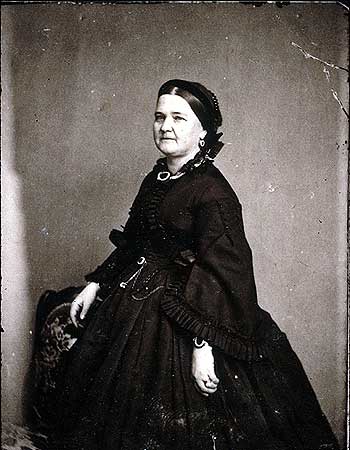
Mary Todd Lincoln [Source]

Mary Todd Lincoln, the 'Republican queen"

Did you know that Mary Todd Lincoln also exercised an extended period of mourning? After President Abraham Lincoln was assassinated on April 15, 1865, Mrs. Lincoln "went into mourning and remained in widow’s clothes until her own death in 1882."  Mourning her husband simply added to an already serious state of grief that began with the 1862 typhoid related death of her dear son, Willie.

The President's widow was in a difficult public position. Believing luxury would shore up confidence in the president's authority, she incurred deep debts beyond her Congressionally-allotted allowance. During this season of Civil War and severe hardship, she "compulsively shopped", applying retail therapy to the furnishings of the White House and her own station of social prominence. 

While Tucker concurs on the absurdity of extremes in Victorian mourning, he chastises the modern Western world's haste of disposition and emotional discharge. "We now treat with hasty neglect the great last fact of life that once obsessed our forebears, and part of the price we pay is the way our observance of death defaults to a threadbare, hollow repetition of theirs." [Source, p.122]

What does the Condolence Coach take away from reading about this era?

  • Grief often causes depression
  • It is not always easy to be with a grieving person, but
  • To judge or impose an arbitrary timeline on a grieving person is unfair
  • Do not give advice about the household or personal property
  • Support- your condolence note- can acknowledge the loss of a wonderful person (use their name!)

Thank you for caring!